

Hey there! As a supplier of FPC 4G Antennas, I often get asked about all sorts of technical stuff related to our products. One question that pops up quite a bit is, "What is the group delay of FPC 4G Antenna?" Well, let's dive right into it and break it down in a way that's easy to understand.
First off, let's talk a bit about what FPC 4G Antennas are. FPC stands for Flexible Printed Circuit. These antennas are super popular because they're flexible, lightweight, and can be easily integrated into all kinds of devices. Whether it's a smartphone, a tablet, or even some IoT devices, FPC 4G Antennas play a crucial role in ensuring a stable and strong 4G connection. You can check out more about our FPC 4G Antenna on our website.
Now, onto the main topic - group delay. Group delay is basically a measure of how long it takes for the envelope of a signal to pass through a system, in this case, our FPC 4G Antenna. In simpler terms, it's the time delay between the input and output of a signal. Why is this important? Well, in a communication system, signals are made up of different frequencies. If the group delay varies too much across these frequencies, it can cause distortion in the signal. This distortion can lead to all sorts of problems, like poor call quality, slow data transfer speeds, and even dropped connections.
Let's take a closer look at how group delay affects the performance of our FPC 4G Antennas. In a 4G network, data is transmitted using a wide range of frequencies. Our antennas need to be able to handle these frequencies efficiently and without introducing too much group delay. If the group delay is too high, the different frequency components of the signal will arrive at the receiver at different times. This can cause inter - symbol interference (ISI), which is a big no - no in communication systems. ISI can make it difficult for the receiver to accurately decode the data, leading to errors and a decrease in overall performance.
On the other hand, if the group delay is relatively constant across the frequency band of interest, the signal will maintain its shape and integrity as it passes through the antenna. This means that the data can be transmitted and received accurately, resulting in a better user experience. For example, when you're streaming a high - definition video on your smartphone, a stable and low - group - delay antenna ensures that the video plays smoothly without buffering or pixelation.
So, how do we ensure that our FPC 4G Antennas have a low and consistent group delay? Well, it all starts with the design process. Our team of engineers uses advanced simulation tools to model the antenna's performance and optimize its design for low group delay. We carefully select the materials and the layout of the antenna to minimize any unwanted delays. Additionally, we conduct rigorous testing on each antenna to make sure it meets our strict quality standards.
Another factor that can affect group delay is the environment in which the antenna is used. For instance, if the antenna is placed near a metal object or in an area with a lot of electromagnetic interference, it can cause the group delay to increase. That's why it's important to consider the installation location and the surrounding environment when using our FPC 4G Antennas.
Now, you might be wondering how group delay compares to other antenna performance metrics. Well, group delay is just one piece of the puzzle. Other important metrics include gain, radiation pattern, and return loss. Gain refers to how well the antenna can focus the signal in a particular direction. A higher gain antenna can transmit and receive signals over a longer distance. The radiation pattern shows how the antenna radiates the signal in space. A well - designed radiation pattern ensures that the signal is distributed evenly in the desired area. Return loss measures how much of the signal is reflected back from the antenna instead of being transmitted. A low return loss indicates that the antenna is well - matched to the transmission line, which is crucial for efficient signal transfer.
All these metrics work together to determine the overall performance of our FPC 4G Antennas. We strive to optimize each of these metrics to provide our customers with the best possible antenna solution.
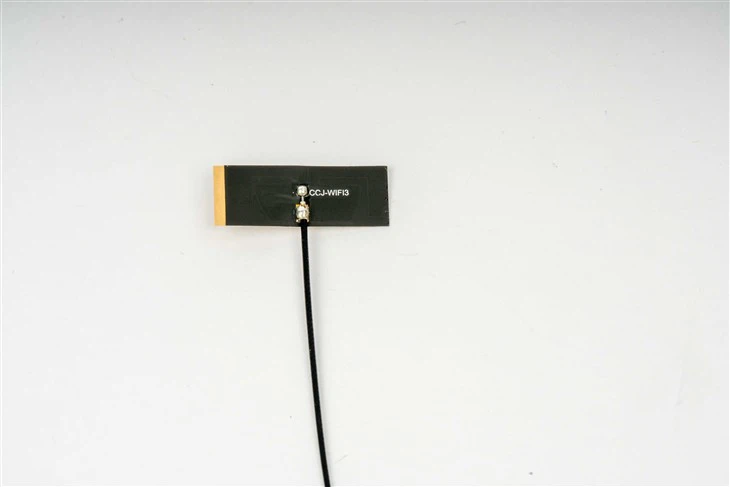
If you're also interested in other types of antennas, we also offer FPC Wifi Antenna. These antennas are designed specifically for Wi - Fi networks and have their own unique performance characteristics.

As a supplier, we understand that our customers have different needs and requirements. Whether you're a large electronics manufacturer or a small startup, we're here to provide you with high - quality FPC 4G Antennas that meet your specific needs. If you're interested in learning more about our products or have any questions about group delay or other technical aspects, don't hesitate to reach out to us. We're always happy to have a chat and discuss how we can help you with your antenna needs.
In conclusion, group delay is an important aspect of the performance of FPC 4G Antennas. By understanding what it is and how it affects the signal, you can make a more informed decision when choosing an antenna for your device. Our team is dedicated to providing you with antennas that have a low and consistent group delay, along with excellent performance in other key areas. So, if you're in the market for FPC 4G Antennas, give us a chance to show you what we can do.
References
- Antenna Theory and Design, by Constantine A. Balanis
- Wireless Communication Systems: Advanced Techniques for Signal Reception, by Andreas F. Molisch